| Method | Advection | Burgers | Elasticity | Navier-Stokes |
|---|---|---|---|---|
| Local | 0.1050 | 0.0016 | 0.3232 | 0.1185 |
| Global | 0.1262 | 0.0019 | 0.2967 | 0.1359 |
| Input-Level | 0.1343 | 0.0023 | 0.2979 | 0.1175 |
| Vanilla FNO | 0.9430 | 0.0369 | 0.5057 | 0.1490 |
Table 1: Relative L2 error comparison (Stage 1).
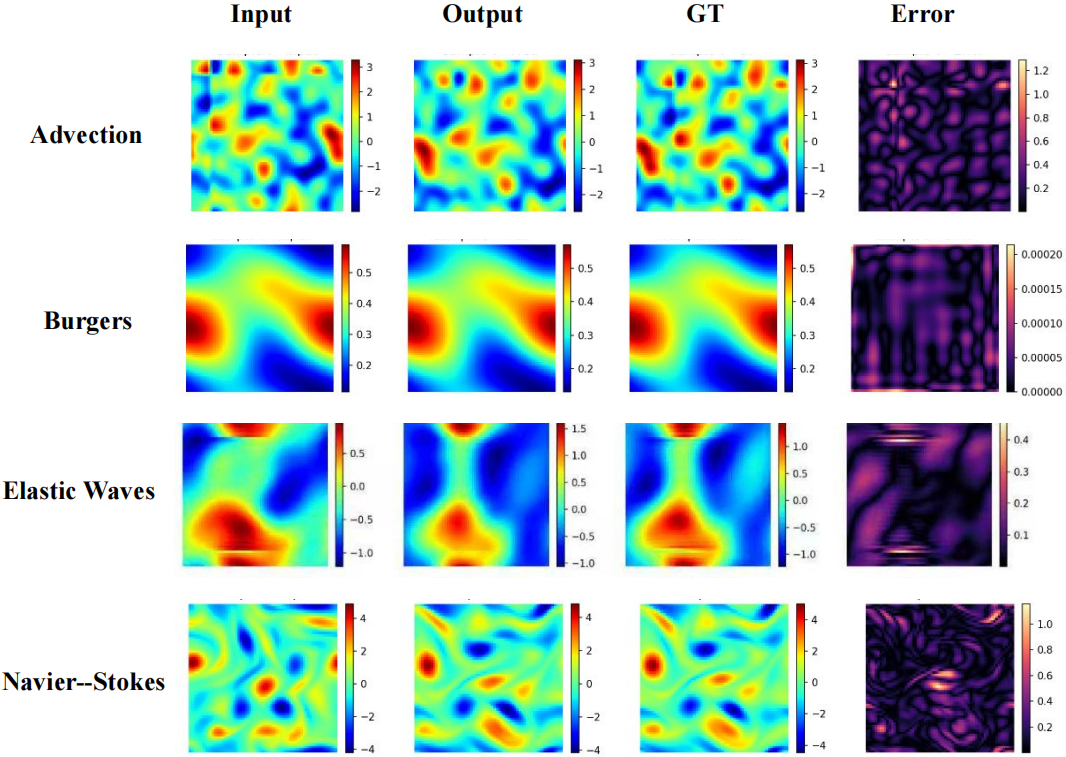
One-step predictions on all four PDE benchmarks using the best-performing conditioned FNO variant for each task. For every benchmark, we show the input field at the rollout start time, the predicted field, the ground-truth field at the same time, and the $L^2$ error.
Learning neural operators for parameter-dependent PDEs requires integrating physical parameters into the operator architecture. We systematically compare three conditioning strategies for Fourier Neural Operators (FNOs): local feature-wise modulation, global channel-wise scaling, and input-level concatenation.
Using identical backbones, we evaluate all mechanisms on four PDE systems—advection, Burgers, elasticity, and Navier-Stokes—and show that conditioning consistently improves parameter generalization. Local modulation performs best on most benchmarks, while global scaling is most effective for linear elasticity.
We systematically compare three distinct architectural modifications to inject physical parameters $p$ into the FNO backbone.
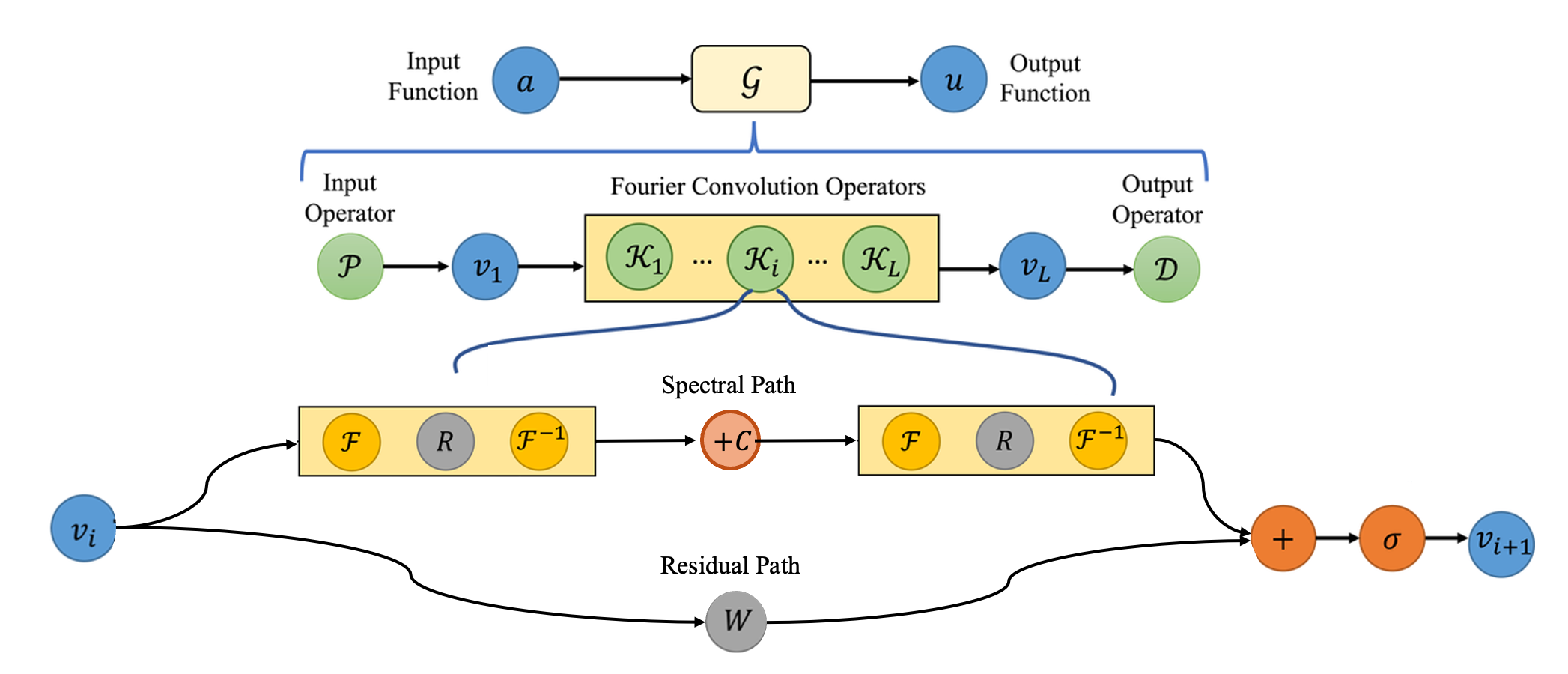
Feature-wise Modulation: Parameters are encoded to produce channel-wise scale and shift values, applied via FiLM layers between spectral blocks. This allows parameters to locally adjust each Fourier block.
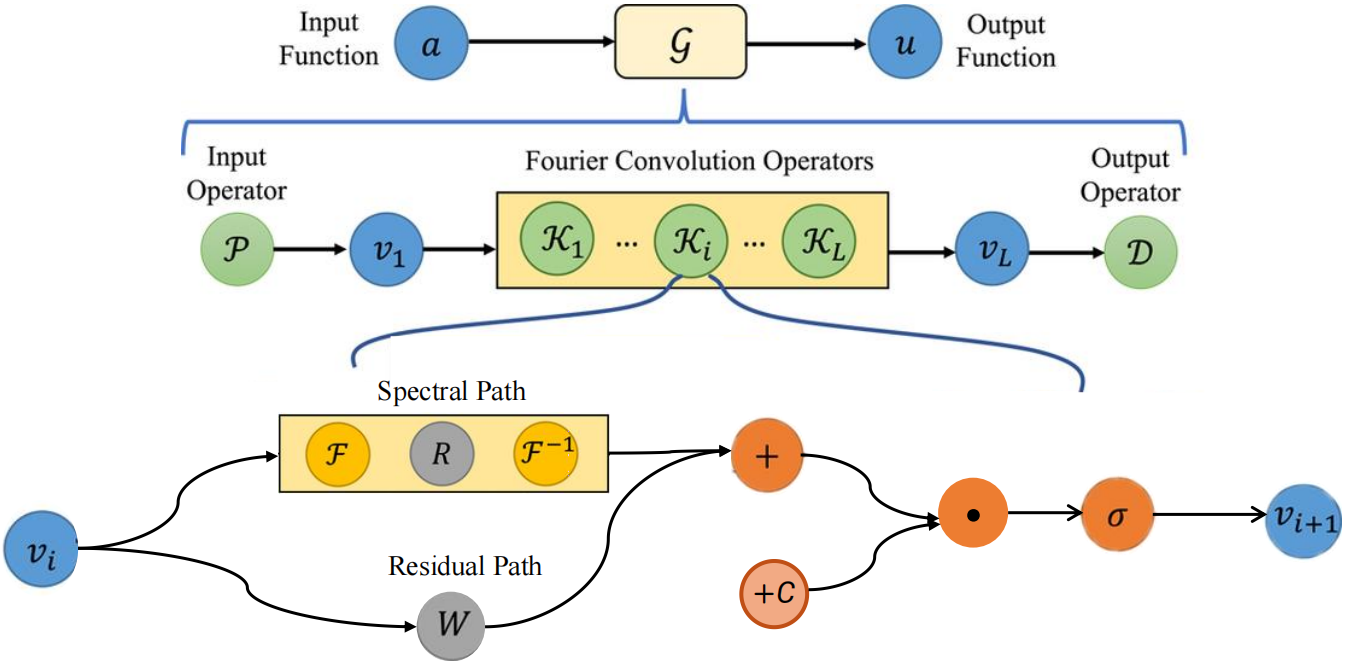
Channel-wise Scaling: Parameters are mapped to a latent vector and used as multiplicative factors on the learned feature map. This introduces a global adjustment per channel without modifying spatial patterns.
(Concatenation Strategy)
Input-Level Conditioning (Concatenation): This is the simplest strategy where physical parameters $p$ are broadcast spatially across the grid and concatenated as extra channels to the input $a(x)$ before the first lifting layer.
While simple to implement, this method forces the network to learn the interaction between parameters and dynamics solely through the standard FNO convolution operations, without explicit modulation mechanisms.
We evaluate our conditioning strategies on four PDE benchmarks with varying physical parameters.
$\partial_t u = \nu \Delta u - \mathbf{v} \cdot \nabla u + s(x, y, t)$
Varying velocity field $v_x$ and $v_y$
$\partial_t u + (u \cdot \nabla) u = \nu \Delta u$
Varying viscosity $\nu$
$\partial_t \mathbf{u} = \mathbf{v}$
$\partial_t \mathbf{v} = (c_p^2 - c_s^2) \nabla(\nabla \cdot \mathbf{u}) + c_s^2 \Delta \mathbf{u}$
Varying P-wave $c_p$ and S-wave speeds $c_s$
$\partial_t \omega + \mathbf{u} \cdot \nabla \omega = \nu \Delta \omega + f(x, y)$
Varying external forcing amplitudes
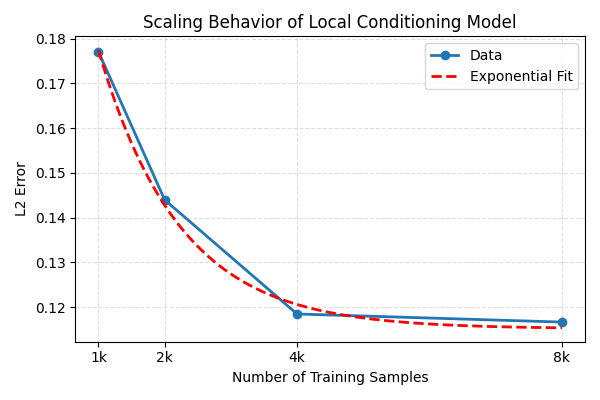
Scaling behavior of the local conditioning model as the number of training samples increases. Performance saturates at approximately 4k samples.
| Method | Advection | Burgers | Elasticity | Navier-Stokes |
|---|---|---|---|---|
| Local | 0.1050 | 0.0016 | 0.3232 | 0.1185 |
| Global | 0.1262 | 0.0019 | 0.2967 | 0.1359 |
| Input-Level | 0.1343 | 0.0023 | 0.2979 | 0.1175 |
| Vanilla FNO | 0.9430 | 0.0369 | 0.5057 | 0.1490 |
Table 1: Relative L2 error comparison (Stage 1).
In Stage 2, we applied the PDE-Refiner training scheme. While effective for some systems, it showed limitations on the Navier-Stokes benchmark due to dominant advective dynamics.
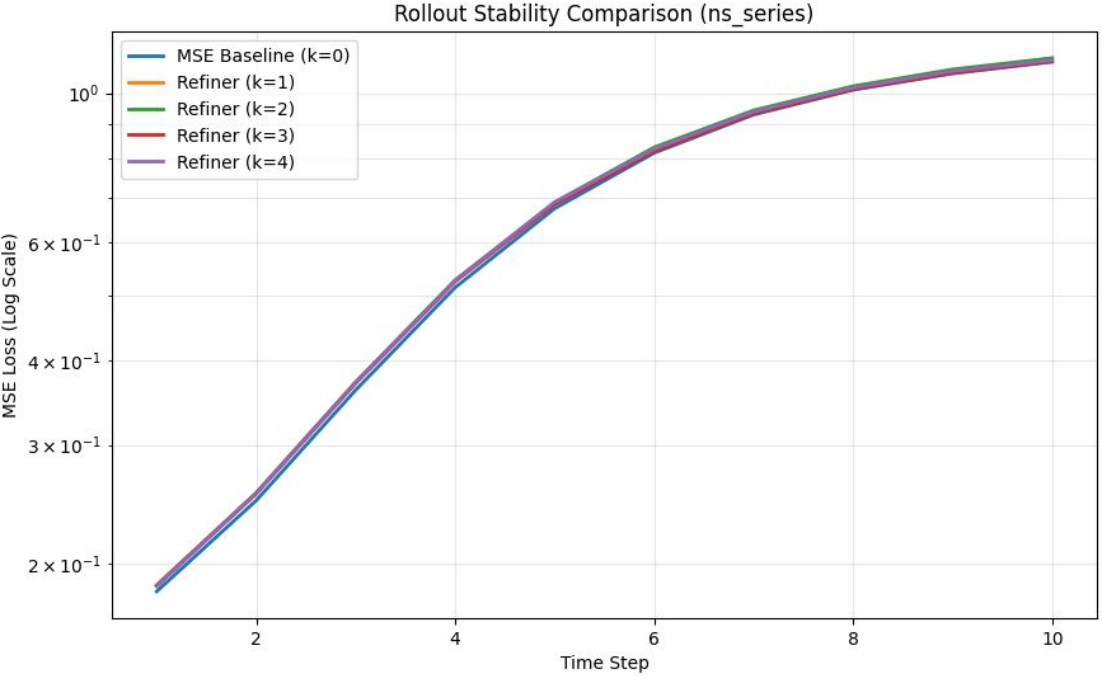
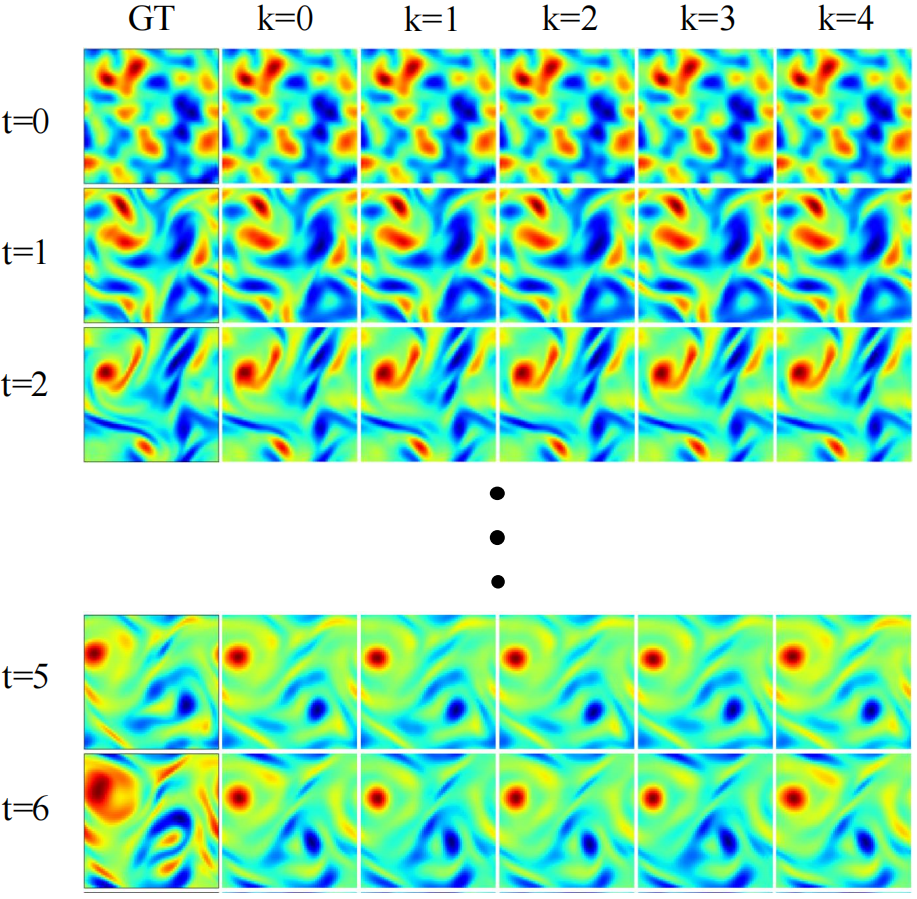
Across refinement depths $k = 1$ to $k = 4$, the error curves almost overlap with the baseline model ($k = 0$), indicating that refinement does not improve long-horizon stability for this system. The highly advective dynamics dominate the evolution, and the correction steps fail to reduce accumulated rollout error.
Across time steps $t = 0$ to $t = 6$, the predicted vorticity fields remain nearly identical for all refinement levels, showing no visible improvement over the baseline.